 |
 |
 |
 |
The Golden Dawn F.A.Q.
i. Introduction.
1. What is the Golden Dawn?
2. How did the Hermetic Order of the Golden Dawn come into being?
3. Is the Hermetic Order of the Golden Dawn a religion?
4. What are the roots of the Golden Dawn?
5. What is the Hermetic tradition?
6. What is the goal of Hermetic spiritual practice?
7. What are Hermetic spiritual practices?
8. What is Alchemy?
9. What is magic?
10. How is astrology important in Hermetic spiritual practice?
11. Where does the Hermetic tradition come from?
12. What is the Rosicrucian tradition?
13. What are Rosicrucian spiritual practices?
14. What is the system of grades used by the Hermetic Order of the Golden Dawn and where do they come from?
15. What is the purpose of the three order system?
16. How is the Golden Dawn connected with the Hermetic and Rosicrucian traditions?
17. How is the Hermetic Order of the Golden Dawn connected with the New Age movement?
18. How is the Golden Dawn connected with Freemasonry?
19. How is the Golden Dawn connected with the SRIA?
20. What connection did Aleister Crowley have with the Golden Dawn?
21. What connection did Israel Regardie have with the Golden Dawn?
22. What is the “Regardie Golden Dawn lineage?”
23. What is the importance of lineage in various spiritual traditions?
24. What is the lineage of the Hermetic Order of the Golden Dawn?
25. What are the major lines of transmission of Golden Dawn lineage?
26. What about “astral initiation”?
27. Is it possible to Self-Initiate myself in the Golden Dawn?
28. Are Golden Dawn Temples still active? How can I become a member?
29. Which order is the real Golden Dawn?
Introduction
Welcome to the Golden Dawn F.A.Q. and Hermetic – Rosicrucian timeline. This website is intended as a scholarly resource devoted to historical research of the Hermetic and Rosicrucian traditions with a special emphasis on the Golden Dawn. We seek to illustrate the unique place of the Golden Dawn within the Hermetic and Rosicrucian traditions, as well how these traditions shaped and formed the Golden Dawn from its inception in 1850, to its founding in 1888, until today.
On this website, you will find a detailed timeline of the major streams of Western esoteric thought, beginning in most ancient times. These include the Hermetic and Rosicrucian traditions, magical grimoires, alchemy and alchemists, and biographical information on most major personalities in the Western esoteric tradition.
Below you will also find answers to the most frequently asked questions (F.A.Q.) about the Golden Dawn in the first major update of the Golden Dawn FAQ in over a decade. You will also find a guide to contemporary Golden Dawn groups on this site, intended as a guide for the perplexed through the Internet Golden Dawn labyrinth.
Sincerely,
The Golden-Dawn.Info Research Team
1. What is the Golden Dawn?
The Hermetic Order of the Golden Dawn is a magical order that was founded in 1888, practicing a form of theurgy and spiritual development. It was probably the single greatest influence on twentieth century western occultism. Concepts of magic and ritual that became core elements of many other traditions, including Wicca, Thelema and other forms of magical spirituality popular today, are drawn from the Golden Dawn tradition. Today’s widespread public interest in tarot likewise derives directly from the Golden Dawn, through decks using Golden Dawn symbolism published by former Golden Dawn members Aleister Crowley and A.E. Waite. The Golden Dawn has also influenced literature through writers W.B. Yeates, A.E. Waite, Algeron Blackwood, and Arthur Machen.
2. How did the Hermetic Order of the Golden Dawn come into being?
What would eventually become the Hermetic Order of the Golden Dawn began in 1850, when Kenneth MacKenzie was initiated by Hungarian Count Apponyi in Austria into a Rosicrucian lineage and was given a collection of 60 folios, called Cypher Manuscripts, containing the structural outline of a series of magical initiation rituals that eventually became the Hermetic Order of the Golden Dawn. MacKenzie was additionally granted a warrant with which to found a branch of this Continental Rosicrucian society in Britain. MacKenzie exercised this warrant by founding two temples in Britain (Hermanoubis Temple N 2 was in Bristol under F.G. Irwin), but that waited in vain for the rituals which were never completed. Following MacKenzie’s death, W. Wynn Wescott obtained copies of these Cypher Manuscripts from his widow, which Wescott, together with fellow freemasons Dr. William Robert Woodman, William Wynn Westcott, and Samuel Liddell MacGregor Mathers used to found the Usis-Urania temple no. 3 of the Hermetic Order of the Golden Dawn in 1888. It should be noted that 1888 is usually given for the year of the founding of the H.O.G.D. and that the two temples founded by Kenneth MacKenzie are customarily referred to as the “Society of Eight.”
3. Is the Hermetic Order of the Golden Dawn a religion?
The H.O.G.D. is not a religion. Although spiritual and metaphysical concepts are the focus of much order work, rather are taught to hold all religions in reverence, for there are elements of the same transcendent truth in all of them. An overall notion of religious tolerance pervades the Golden Dawn, for one is also reminded from the very first initiation ritual, to "Remember that you hold all Religions in reverence, for there is none but contains a Ray from the Ineffable Light that you are seeking."
4. What are the roots of the Golden Dawn?
The Hermetic Order of the Golden Dawn is a nineteenth century manifestation of both the Hermetic and Rosicrucian traditions and occupies a very specific place within each of these. There are many additional influences and sources of material which have been incorporated into the teachings and rituals of the Hermetic Order of the Golden Dawn. Additional influences on Golden Dawn concepts and work include: Christian mysticism, Qabalah, the religion of Ancient Egypt, Freemasonry, Theosophy, Eliphas Levi, Papus, Enochian magic, and Renaissance grimoires.
5. What is the Hermetic tradition?
The Hermetic tradition is a set of philosophical and religious beliefs based primarily upon the writings attributed to Hermes Trismegistus, who is put forth as a wise sage and Egyptian priest, and who is commonly seen as synonymous with the Egyptian god Thoth. The Hermetic tradition commonly attributes forty two books to his credit. However, most of these books are reported to have been destroyed when the Great Library of Alexandria was razed. There are three major works which are widely known texts for Hermetic beliefs:
The Emerald Tablet of Hermes Trismegistus is a short work which coins the well known term in occult circles "As above, so below." As the story is told, this tablet was found by Alexander the Great at Hebron supposedly in the tomb of Hermes. The actual text of that maxim is "That which is Below corresponds to that which is Above, and that which is Above corresponds to that which is Below, to accomplish the miracle of the One Thing." The tablet also references the three parts of the wisdom of the whole universe, to which Hermes claims his knowledge of these three parts is why he received the name Trismegistus (thrice great, or Ao-Ao-Ao meaning "greatest"). The Corpus Hermeticum is the body of work most widely known and is the aforementioned Greek texts. These sixteen books are set up as dialogues between Hermes and a series of others. The first book involves a discussion between Poimandres (also known as Nous and God) and Hermes, supposedly resulting from a meditative state, and is the first time that Hermes is in contact with God. Poimandres teaches the secrets of the Universe to Hermes, and later books are generally of Hermes teaching others such as Asclepius and his son Tat. The four classical elements of earth, water, air, and fire are used often in alchemy, and are alluded to several times in the Corpus Hermeticum.
The Kybalion: Hermetic Philosophy, is a book published in 1912 CE anonymously by three people calling themselves the "Three Initiates". Many of the Hermetic principles are explained in the book.
6. What is the goal of Hermetic spiritual practice?
In the Hermetic belief system, all is in the mind of The All. Hermeticism acknowledges that there exist many gods, but that these deities, along with all other beings, exist within, and are created by, The ALL. As expressed in the Kybalion: "We have given you the Hermetic Teaching in regarding the Mental Nature of the Universe - the truth that 'the Universe is Mental - held in the Mind of THE ALL.'
Everybody and Everything in the universe is part of this entity. As everything is mental, it is also a vibration. All vibrations vibrate from the densest of physical particles, through mental states, to the highest spiritual vibrations. In Hermeticism, the only difference between different states of physical matter, mentality, and spirituality is the frequency of their vibration. The higher the vibration, the further it is from base matter. The goal of Hermetic practice is to transmute the base matter of the physical body into ever more refined and pure forms of energy and consciousness.
7. What are Hermetic spiritual practices?
One account of how Hermes Trismegistus received the name "Trismegistus," meaning "Thrice Great," is because, as he claims in The Emerald Tablet of Hermes Trismegistus, he knows the three parts of the wisdom of the whole universe. These are the Hermetic triad (Trivium Hermeticum) of spiritual practices: alchemy, astrology, and theurgy, by means of which spiritual attainment is accomplished in the Hermetic Tradition.
8. What is Alchemy?
Alchemy - The Operation of the Sun - For Hermeticism, Alchemy is not simply the changing of physical lead into physical gold. Hermetic initiates derided those ‘alchemists’ trying to manufacture gold as mere ‘puffers,’ unable to understand the subtle allegories of Hermetic alchemical texts. Behind allegorical stages of chemical distillation and fermentation in order to quicken Nature's processes and to bring a natural body to perfection., lies the alchemical art of transmutation (Ars Transmutoria). In this “Great Work” (Opus Magnum) of Hermetic alchemy, the first matter (Prima Materia), which is the physical body (symbolized by lead = Saturn, Chronos, ruled by time) is transmuted into higher ever more rarified forms of energy, creating a ‘body of light’ (symbolized by gold = Sun, a solar body), with the ultimate goal of achieving conscious immortality (Divine Consciousness) in a single incarnation.
This is accomplished by means of a powerful elixir of life called the Philosophers Stone, which, when ingested, transmutes the physical body and purifies its vibration. The composition of the Philosopher’s Stone remains one of the most carefully guarded secrets of the Hermetic tradition. Alchemical texts clearly state, however, that the Philosophers Stone is created by purifying Mercury into Philosophical Mercury. This Mercury, whose true nature remains concealed from non-initiates by allegory, is transmuted and purified by “cooking” it with the subtle fires of the physical body, including love and sexuality.
The actual techniques of the royal art (Ars Royal) of alchemy remain the most powerful and secret part of the Hermetic tradition and are carefully guarded in the highest grades of Hermetic Order of the Golden Dawn. Alchemy is seen as the "key" to theurgy, the ultimate goal of which is to become united with higher counterparts, leading to Divine Consciousness.
9. What is magic?
Theurgy (Magic) - The Operation of Moon - Theurgy translates to "The Science or art of Divine Works." There are two different types of magic, according to Giovanni Pico della Mirandola's Apology, completely opposite of one another. The first is ???te?a, Goëtia, black magic reliant upon an alliance with evil spirits (i.e. demons). The second is Theurgy, divine magic reliant upon an alliance with divine spirits (i.e. angels, archangels, gods). In the practice of Hermetic theurgy, these are invoked in order to awaken elemental, planetary, an zodiacal forces in the physical and energetic bodies. Theurgy is the practical aspect of the astrology. Ritual magic and all modern magical traditions ultimately derive from Hermetic theurgy.
10. How is astrology important in Hermetic spiritual practice?
Astrology - The Operation of the Stars – the three disciplines of the Trivium Hermeticum; alchemy, theurgy, and astrology are completely interdependent on one another. Hermetic astrology is not a mere passive tool for fortune telling as astrology is understood in modern times, but rather actively employs stellar influences for spiritual development using alchemy and theurgy. Hermetic alchemy and theurgy are likewise dependent on astrological cycles. Thus Hermetic theurgy can be understood as a sort of astrological magic.
11. Where does the Hermetic tradition come from?
The Hermetic tradition arose out of the confluence of Egyptian and Greek cultures in Alcxandria in Ptolomaic Egypt. The earliest roots of the Hermetic tradition are found in the astronomical, spiritual traditions of Sumeria, then in Chaldea and Egypt before reaching Europe with the Greek and Roman empires. In Greece, this early wisdom found its way into the Pythagoraen tradition and filtered into the Orphic, Delphic, and Elusenian mysteries. In Rome, it arrived from Egypt with the Hermetic and Gnostic traditions, then spread through the Mythraic and the Isiac mysteries, later giving rise to Neo-Platonism. The Hermetic tradition, being opposed by the Church, became a part of the occult underworld, intermingling with other occult movements and practices. The infusion of Hermeticism into occultism has given it great influence in Western magical traditions. Hermeticism's spiritual practices were found very useful in magical work, especially in Theurgic (divine) practices as opposed to Goëtic (profane) practices, due to the religious context from which Hermeticism sprang forth. Using the teachings and imagery of the Jewish Qabalah and Christian mysticism, Hermetic Theurgy was used effectively and in a context more easily understood by Europeans in the Middle Ages and Renaissance. Hermetic magic underwent a flowering in Western Europe, when the Hermetic Order of the Golden Dawn was founded in 1888.
12. What is the Rosicrucian tradition?
The Rosicrucian tradition is a flowering of Hermeticism, a rose blossoming upon the cross of the Hermetic tradition. The rose may also be seen to symbolize the soul and the cross, the body of the four elements. In other words, the human soul crucified on the cross of the material plane. This rosy cross may be similar to the Egyptian use of the ankh.
According to a legend of the 18th century Golden and Rosy Cross order in Germany, the Rosicrucian order was created when an Alexandrian Gnostic sage named Ormus and his six followers were converted by Mark, one of Jesus' disciples. From this conversion, Rosicrucianism was supposedly born, fusing early Christianity with Egyptian mysteries.
Historical research indicates the origin of the Rosicrucian tradition in a group of German Protestants between 1607 and 1616 (early 17th century), when three anonymous documents were elaborated and published in Europe: Fama Fraternitatis Rosae Crucis, Confessio Fraternitatis, and Chymical Wedding of Christian Rosenkreutz anno 1459. The publications of these documents caused immense excitement throughout Europe. These works declared the existence of a secret brotherhood of alchemists and sages who were preparing to transform the arts, sciences, religion, and political and intellectual landscape of Europe while wars of politics and religion ravaged the continent. It is probable that the first work was circulated in manuscript form about 1610, even though there was no mention of the order before that decade. In his autobiography, Johann Valentin Andreae (1586–1654) claimed the anonymously published Chymische Hochzeit (Chymical Wedding of Christian Rosenkreutz) as one of his works. The German “Gold und Rosenkreuzer” (Golden and Rosy Cross) was first mentioned by the alchemist Samuel Richter (Sincerus Renatus)[1] in Prague in the early 18th century, then appeared as an organized order open only to Master Masons in 1756. This group, under the leadership of Hermann Fictuld, reformed itself extensively in 1767, and again in 1777 under the leadership of its Imperator, "Phoebron" (Dr. Bernhard Joseph Schleiss von Löwenfeld). The Order was organized in local circles, which practiced the Hermetic triad of disciplines; alchemy, theurgy (magic), and astrology.
Many elements of the Gold und Rosenkreutzer were incorporated in 1888 into the Hermetic Order of the Golden Dawn, including its grade structure (Juniores, Theoretici, Practici, Philosophi, Minores, Majores, Adepti exempti, Magistri und Magi.), titles, passwords, etc. The Second Order of the Hermetic Order of the Golden Dawn the Rosae Rubeae et Aureae Crucis, founded by S.L. MacGregor Mathers in 1892, likewise practices the Hermetic triad of disciplines; alchemy, theurgy (magic), and astrology.
13. What are Rosicrucian spiritual practices?
Contrary to modern misunderstanding, Rosicrucian spiritual practice is not some mystical mélange of New Age and self-help notions from pop psychology as has been popularized by certain, modern, pseudo-Rosicrucian groups. From the beginning, legitimate Rosicrucian schools have at all times taught and practiced the Hermetic triad of disciplines (Trivium Hermeticum): alchemy, astrology, and theurgy (magic), as was the case, for example, with the German Golden and Rosy Cross order in the eighteenth century.
14. What is the system of grades used by the Hermetic Order of the Golden Dawn and where do they come from?
The grade structure used by the Hermetic Order of the Golden Dawn derives directly from the German Gold und Rosenkreutz (Golden and Rosy Cross) order of the eighteenth century. The Gold und Rosenkreutz order primarily practiced Hermetic alchemy and used the following grade structure:
Gold und Rosenkreutz Order
1. Juniorus
2. Theoricus
3. Practicus
4. Philosophus
5. Adeptus Minor
6. Adeptus Major
7. Adeptus Exemptus
8. Magister Templi
9. Magus
The Hermetic Order of the Golden Dawn further developed the theurgical (magical) side of the Hermetic and Rosicrucian traditions. A stream of Jewish, Qabalistic influence entered the H.O.G.D. from the order of the “Asiatic Brethren,” another Rosicrucian order of eighteenth Century Germany. The H.O.G.D., therefore, modified the Gold und Rosenkreutz grade structure, causing it to correspond to the Sephiroth on the Qabalistic tree of life. Moreover, the H.O.G.D. organized these grades into a three order system and attributed certain magical (elemental and astrological) forces to each of the grades, as follows:
| Name | Element | Planet | Sephira |
| First Order (Hermetic Order of the Golden Dawn) | |||
| Neophyte (0=0) | (Introductory) | ||
| Zelator (1=10) | Earth | Earth | Malkuth, Kingdom |
| Theoricus (2=9) | Air | Moon | Yesod, Foundation |
| Practicus (3=8) | Water | Mercury | Hod, Splendour |
| Philosophus (4=7) | Fire | Venus | Netzach, Victory |
| Second Order (R.R. et A.C.) | |||
| Portal | Spirit | (Introductory) | |
| Adeptus Minor (5=6) | Sun | Tiphareth, Beauty | |
| Adeptus Major (6=5) | Mars | Gevurah, Might | |
| Adeptus Exemptus (7=4) | Jupiter | Chesed, Mercy | |
| Third Order (Name Unknown) | |||
| Magister Templi (8=3) | Saturn | Binah, Understanding | |
| Magus (9=2) | Zodiac | Chokmah, Wisdom | |
| Ipsissimus (10=1) | Kether, Crown | ||
The grades of Neophyte through Philosophus comprise the First, or Outer Order. A grade called the "Portal" comes between 4=7 and 5=6, and this contains some very powerful symbolism on the transition between the Outer and Inner "Mysteries." The three Adept grades comprise the Second, or Inner Order (Rosae Rubeae et Aureae Crucis), and are normally only open to those who pass rigorous examinations and are chosen on other qualifications. The final three grades (which refer to the "Supernal" sephiroth) comprise the Third Order of Masters. There is considerable disagreement among Order sources as to whether living human beings can attain these final mystical grades (not unlike the Bodhisattvas of Buddhism, it seems).
15. What is the purpose of the three order system?
In modern esotericism, there exist three types of esoteric orders. These fall into two general categories; symbolical and operative. Among the operative orders, there are those which are analogical (lunar) or direct (solar). At the simplest level we find the ”symbolical” orders like Freemasonry and the outer order of the original Hermetic Order of the Golden Dawn. In these orders, spiritual wisdom is presented in symbolical form; either exclusively during the initiation rituals in the case of Freemasonry, or together with supplemental study materials as in the case of the original Hermetic Order of the Golden Dawn in the outer.
At the more advanced level come the so-called, ”operative” orders. Operative orders employ special magical or alchemical “operations” for spiritual development. In a further distinction, there exist two kinds of operative systems and orders. Firstly, in the “analogical,” operative systems, practitioners operate with systems referring by analogy to yet higher, more direct, and more advanced operations and systems. Analogical operative systems are thus called “lunar” mysteries as, much as the moon reflects the light of the Sun, their light is reflected by analogical reference to higher operative processes. Nonetheless, despite her reflective nature, the moon indeed remains a luminary. So also the analogical operative systems remain powerful tools for spiritual development in and of themselves, despite their analogical nature.
Introduction—Neophyte 0=0
Zelator 1=10
Theoricus 2=9
Practicus 3=8
Philosophus 4=7
Second Order:
Intermediate—Portal Grade
Adeptus Minorus 5=6
Adeptus Majorus 6=5
Adeptus Exemptus 7=4
Third Order:
Magister Templi 8=3
Magus 9=2
Ipsissimus 10=1
The paired numbers attached to the Grades relate to positions on the Tree of Life. The Neophyte Grade of "0=0" indicates no position on the Tree. For the others, the first numeral is the number of steps up from the bottom (Malkuth), and the second numeral is the number of steps down from the top (Kether).
The First Order Grades were related to the four Classical Elements of Earth, Air, Water and Fire, respectively. The Aspirant to a Grade received instruction on the metaphysical meaning of each of these Elements, and had to pass a written examination and demonstrate certain skills to receive Admission to that Grade.
The Portal Grade was the initiation ritual for admittance to the Second Order. The Circle of existing Adepts from the Second Order had to consent to allow an Aspirant to join the Second Order.
The Second Order was not, properly, part of the "Golden Dawn", but a separate Order in its own right, known as the R.R. et A.C. The Second Order directed the teachings of the First Order, and was the governing force behind the First Order.
After passing the Portal, the Aspirant was instructed in the techniques of practical Magic. When another examination was passed, and the other Adepts consented, the Aspirant attained the Grade of Adeptus Minor (5=6). There were also four sub-Grades of instruction for the Adeptus Minor, again relating to the four Outer Order grades.
A member of the Second Order had the power and authority to initiate aspirants to the First Order, though usually not without the permission of the Chiefs of his or her Lodge.
16. How is the Golden Dawn connected with the Hermetic and Rosicrucian traditions?
The Hermetic Order of the Golden Dawn and its Second Order, the R.R. et A.C. hold lineage in both the Hermetic and Rosicrucian traditions.
17. How is the Hermetic Order of the Golden Dawn connected with the New Age movement?
Israel Regardie’s publication of H.O.G.D. initiation rituals and skeletal aspects of the R.R. et A.C. magical system has in recent years been exploited by a number of newly created American groups calling themselves “Golden Dawn,” yet having no legitimate connection with the Hermetic Order of the Golden Dawn founded in Great Britain in 1888. Certain of these groups, as is the case with numerous modern Rosicrucian groups, have attempted to market New Age techniques like “guided fantasy” or as “traditional” Golden Dawn spiritual practices. In reality, New Age techniques have nothing to do with the traditional practices of the H.O.G.D., which are those of the Hermetic and Rosicrucian traditions, the “Trivium Hermeticum” of alchemy, theurgy (magic), and astrology.
18. How is the Golden Dawn connected with Freemasonry?
Although the three founders of the Isis-Urania temple no. 3 of the Hermetic Order of the Golden Dawn in 1888, Dr. William Robert Woodman, William Wynn Westcott, and Samuel Liddell MacGregor Mathers, were all three Freemasons, there exists no formal connection between the H.O.G.D. and Freemasonry, despite false but persistent rumors that the Golden Dawn was created by the Freemasons.
19. How is the Golden Dawn connected with the SRIA?
Although the three founders of the Isis-Urania temple no. 3 of the Hermetic Order of the Golden Dawn in 1888, Dr. William Robert Woodman, William Wynn Westcott, and Samuel Liddell MacGregor Mathers, were all three members of the Societas Rosicruciana in Anglia, there exists no formal connection between the H.O.G.D. and the S.R.I.A., despite false but persistent rumors that the Golden Dawn was created by the S.R.I.A.
20. What connection did Aleister Crowley have with the Golden Dawn?
Aleister Crowley, the most renowned magic practitioner and theoretician of the twentieth century, was initiated into the Hermetic Order of the Golden Dawn in 1898, introduced by George Cecil Jones. He was befriended by Mathers, whom he eventually betrayed, nearly destroying the Golden Dawn by publishing its secret rituals and teachings. Having left the Golden Dawn, in 1907 Crowley founded his own order, the Argentum Astrum (AA; Silver Star). He later went on to become the head of the Ordo Templi Orientis (O.T.O.).
21. What connection did Israel Regardie have with the Golden Dawn?
Israel Regardie (born Francis Regudy) was born in 1907 in London, England to poor Jewish immigrant parents and emigrated to the United States with his family at age 14. Regardie became a ritual magician, a student of Aleister Crowley, and later a chiropractor who utilized the thought of Wilhelm Reich in his work. Beginning in 1928, Regardie traveled through Europe as Crowley's lover, secretary, and student. In 1934, after parting with Crowley, Regardie joined the Stella Matutina, a schismatic offshoot of the Hermetic Order of the Golden Dawn, where he eventually attained the Adeptus Minor (5=6) grade. Regardie eventually broke his vows of secrecy and published the Golden Dawn initiation rituals and skeletal aspects of R.R. et A.C. magical teachings in 1937. Following Regardie’s unauthorized publication, he was shunned by the Greatly Honored Chiefs by senior members of the Stella Matutina, who warned junior members not to purchase Regardie’s books.
Due to Regardie’s publications, the Golden Dawn’s teachings have subsequently impacted nearly every aspect of the Western esoteric tradition and great public interest has been awakened in the Golden Dawn’s magical system. This has been a mixed blessing, however, as the Golden Dawn was nearly destroyed by it as well. Many Golden Dawn and derivative order temples closed or became dormant following Regardie’s publication of original H.O.G.D. and R.R. et A.C. material.
Even worse, the internet has been flooded by a host of recent, American groups confusingly calling themselves “Golden Dawn,” but having no connection whatsoever to the original, Hermetic Order of the Golden Dawn, founded in Europe in 1888. This has resulted in a great deal of public confusion.
The teachings of most of these Regardie-based groups derive, almost without fail, entirely from Israel Regardie’s published Golden Dawn material, which dead-ends at the 5=6 level. Even worse, certain of these groups have replaced physical initiation in real temples with the dubious practices of so-called, "self" or "astral" initiation. Others have diluted original Golden Dawn teachings by mixing them with outside traditions like Martinism or Thelema. The worst of these groups, Robert Zink's so-called, "Esoteric Order of the Golden Dawn," has been known even to engage in cult-like practices and introduced dangerous, non-traditional practices like blood sacrifice, and the ritual scarring and flogging of candidates into the rituals traditionally associated with the Golden Dawn. In such an environment with such disparate groups calling themselves “Golden Dawn,” the notion of “lineage” takes on additional importance to protect an unsuspecting public from confusion.
22. Is there a “Regardie Golden Dawn lineage?”
The publications of Israel Regardie, unfortunately, have recently engendered a host of modern, American groups on the Internet calling themselves “Golden Dawn,” but having no connection to the original Hermetic Order of the Golden Dawn, founded in Europe in 1888. The teachings of these Regardie-based groups derive almost without fail, entirely from the Golden Dawn material published by Israel Regardie, which dead-ends partially through the Adeptus Minor (5=6) level. In desperate mover to give themselves an air of legitimacy, certain Regardie-based groups have deliberately created a myth of a “Regardie Golden Dawn lineage.” Such a notion, however, is highly problematic.
Israel Regardie knew that he had no authority to initiate or grant a charter to anyone and honestly admitted this on numerous occasions, as for example in the attached letter. To begin with, Regardie was never even initiated in the Golden Dawn but rather only in the schismatic Stella Matutina, founded by former Golden Dawn Adept turned rogue, R.W. Felkin. Moreover, Regardie was never granted dispensation to initiate anyone by the G.H. Chiefs of the Stella Matutina and certainly had no authority to grant any sort of charter or even to consecrate a Vault of the Adepti.
Fully aware of these facts, Israel Regardie nonetheless did consecrate a Vault of the Adepti in 1982 in order to initiate his student, Cris Monnastre, into the Adeptus Minor (5=6) grade. These events provided fertile soil for a myth of a “Regardie Golden Dawn lineage” to be deliberately cultivated by certain Regardie-based groups following Regardie’s death. It should be noted that, in his life, Regardie only had four students. These were Cris Monnastre, William Kennedy, Larry Epperson, and Alan Miller (Christopher Hyatt). Regardie never endorsed any “Regardie-based” Golden Dawn group or order, although this imprimatur has been putatively claimed by a variety of organizations following his death.
One could potentially argue with some legitimacy that Israel Regardie has become the progenitor of his own occult school with its own lineage deriving exclusively from Israel Regardie, as is the case with numerous lineages deriving from teachers in Zen and Tibetan Buddhism in the East. In this limited sense, the Regardie-based groups could perhaps honestly claim a “Regardie lineage.” Dishonesty enters and public confusion arises, however, when Regardie-based groups deliberately attempt to conflate such a “Regardie lineage” with a “Golden Dawn” lineage, which by his own clear admission, was never Regardie’s to bestow.
23. What is the importance of lineage in various spiritual traditions?
The concept of lineage is found not only in esoteric orders, but also in spiritual traditions of the East, as well as in Christianity and Freemasonry in the West. Lineage, much like trademarks, may serve to prevent public confusion about a given spiritual tradition. Lineage may also be a formal means of mutual recognition, as in the case of Freemasonry, which uses charters and systems of mutual recognition between Grand lodges to establish ‘regularity,’ or finally, it may carry with it a spiritual transmission or realization, as in the case of Dharma transmission in Zen Buddhism.
Zen Buddhism, for example, maintains records of their historical teachers who, according to the traditional history of that school, have passed the Dharma from generation to generation in an unbroken line since the time of the Buddha. Dharma transmission is the formal confirmation by a master of Zen or Chan Buddhism of a student's awakening. This one-to-one transmission is said to trace back over 2,500 years to Gautama Buddha when he gave dharma transmission to his disciple Mahakasyapa, who is regarded as the first patriarch of Zen in India.
In Christianity, the doctrine of Apostolic Succession maintains that the Christian Church today is the spiritual successor to the original body of believers in Christ, composed of the Apostles. In pre-Protestant Reformation Churches, Apostolic Succession is claimed as having been passed through unbroken lines of bishops beginning with the original Apostles.
In esotericism, numerous orders use lineage as a means of ensuring a direct transmission of spiritual principles and energies. Lineage, like trademarks, is also a basic form of protection for the public, that what members find is actually what they associate with the name or the spiritual tradition.
Martinist orders, for examples all claim lineage deriving from Louis-Claude de St. Martin. L'Ordre Martiniste (the Martinist Order) came about in 1884 when Gerard Encausse (Papus) met August Chaboseau. They discovered that they had both apparently received Martinist initiation through two different chains of succession which linked back to Saint-Martin and his original disciples. Papus claimed to have come into the possession of the original papers of de Pasqually and to have been given authority in the Rite of Saint-Martin by his friend Henri Viscount Delaage. However, Encausse realized that there was a "missing link" in his own chain of succession: he and Chaboseau therefore "swapped initiations" in order to consolidate their lineages.
24. What is the lineage of the Hermetic Order of the Golden Dawn?
The question of the lineage of the Hermetic Order of the Golden Dawn when it was founded in 1888, hinges upon the source of origin of documents known as the “Cypher Manuscripts.” The “Cypher Manuscripts” are a collection of 60 folios containing the structural outline of a series of magical initiation rituals that in 1888 became the first order of the Hermetic Order of the Golden Dawn (comprising the Neophyte (0-0), Zelator (1=10), Theroricus (2=9), Practicus (3=8) and Philosophus (4=7) grades). Wynn Wescott claimed to have obtained these manuscripts from A.F.A. Woodford, who had found them in a secondhand bookstall on Wellington Road in London, and who gave them to his friend Westcott to be decoded. Wescott claimed to have found among these folios the name and address of a certain Anna Sprengel of Germany, a member of a Rosicrucian order in which she was known as Soror S.d.A. Wescott allegedly wrote to her and obtained charter for Isis-Urania temple no. 3 of the Hermetic Order of the Golden Dawn in London. During a later dispute, S.L. MacGregor Mathers claimed that the Anna Sprengel letters had been forged by Wescott. This led scholars Ellic Howe and R.A. Gilbert to claim that the Golden Dawn had been based on a forgery from the beginning.
Recent scholarship, however, has indicated that the Cypher Manuscripts were actually obtained by Wescott from the widow of Masonic scholar and Rosicrucian, Kenneth MacKenzie, who had received a Rosicrucian initiation and affiliation from the Hungarian Count Apponyi, while MacKenzie was living in Austria. It now appears that the Cypher manuscripts were given to MacKenzie by Count Apponyi together with a Rosicrucian lineage, with which to found the Hermetic Order of the Golden Dawn.
To understand why Wescott went to such lengths to obfuscate the true origins of the cipher manuscripts, one must also consider that Wescott was also the Supreme Magus of the Societas Rosicruciana in Anglia (S.R.I.A.), a Masonic Rosicrucian society founded by R.W. Little in 1867. It is today apparent that Wescott deliberately attempted to appropriate the Rosicrucian lineage of Kenneth MacKenzie destined for the Hermetic Order of the Golden Dawn instead for the S.R.I.A.
Under Wescott’s tenure as Supreme Magus of SRIA, roll books were forged to portray MacKenzie as a founder of S,.R.I.A. moving his name form number 114 to 0 and following MacKenzie’s death rumors were circulated that he had communicated his Rosicrucian lineage to Little.
It is clear that the true lineage of the Hermetic Order of the Golden Dawn derives from the Continental European order of Adepts represented by Count Apponyi, who initiated Kenneth MacKenzie and are the source of origin of the Hermetic Order of the Golden Dawn. S.L. MacGregor Mathers claimed to have reestablished contact with representatives of this order in Paris in 1891, to whom Mathers referred as the “Secret Chiefs,” and whom Mathers claimed gave him the rituals and curriculum for the Golden Dawn’s Rosicrucian Second Order, the R.R. et A.C., which Mathers founded in 1892 (comprising the Adeptus Minor (5=6), Adeptus Major (6=5) and Adeptus Exemptus (7=4) grades. The European headquartered Hermetic Order of the Golden Dawn claims to have reestablished contact with representatives of Mathers’ “Secret Chiefs” in Paris once again in 2002, and to have received everything for the Third Order that had been envisioned for the Golden Dawn since its inception in 1888. These materials included the initiation rituals for the Golden Dawn’s three highest grades (called “Magisteria”); Magister Templi (8-3), Magus (9=2) and Ipsissimus (10=1). This continental order of Hermetic alchemists called the “Secret Chiefs” by Mathers, claim to have an unbroken Hermetic lineage, with spiritual techniques of “Hermetic Inner Alchemy” that have been passed down from master to disciple, since the birth of the Hermetic tradition in Alexandrian Egypt. Thus we see that the uniquely Western lineage of the Hermetic Order of the Golden Dawn, founded in 1888 is not merely a formal lineage as is the case with Freemasonry, but involves a spiritual transmission as well, as is the case with the lineages of Tibetan and Zen Buddhism in the East.
25. What are the major lines of lines of Transmission of Golden Dawn lineage?
The primary lines of transmission of the Hermetic and Rosicrucian lineages of the Golden Dawn have been to Kenneth MacKenzie through Count Apponyi in 1850, to S.L. MacGregor Mathers in 1891, and to David Griffin in 2002 through Fratres Lux E Tenebris. Important auxiliary lines of transmission have passed through Desmond Bourke, Countess Tamara Bourkoun, and Marquis Nicholas Tereschenko.
Count Apponyi
Count Apponyi of Hungary was a Rosicrucian, representing an extremely ancient and secretive Continental European order of Hermetic alchemists, to whom S.L. MacGregor Mathers would later refer to as the "Secret Chiefs" (Geheime Oberen in German).
Apponyi transmitted to MacKenzie certain Hermetic and Rosicrucian lineages together with esoteric transmissions with which to found what in 1888 became the Hermetic Order of the Golden Dawn® in Britain. MacKenzie encrypted certain of these documents using a code from Trithemius’ Polygraphiae, into "Cipher Manuscripts," with which the Hermetic Order of the Golden Dawn was later founded.
It should be noted that at the time of MacKenzie’s initiation, both the Gold und Rosenkreutz (Golden and Rosy Cross) order and the order of the Asiatic brethren were active in Austria and that the grade structure of the Gold und Rosenkreutz order found its way directly into the Golden Dawn. Moreover, the name that MacKenzie chose for the first phase of the Golden Dawn, Fratres Lucis, was actually a common name for the Asiatic Brethren. Further, the very name of the order, derives directly from the Frankfurt Jewish Masonic Lodge, "Loge zur aufgehenden Morgenrothe, "Chabrath Zereh Boqer Aour" in Hebrew, which may be rendered in English as Order of the Golden Dawn. Finally, it should additionally be noted that among the senior members of this lodge, were some of the most prominent figures of the Asiatic Brethren to be found.
Kenneth MacKenzie (1833 - 1886)
Kenneth MacKenzie was a noted Freemasonic Scholar and Rosicrucian, born in London in 1833. In 1844 his family moved to Vienna, where in approximately 1850 MacKenzie was initiated by Count Apponyi, receiving certain Hermetic and Rosicrucian lineages together with the material for the Cypher Manuscripts with which the Hermetic Order of the Golden Dawn eventually was established. As the first phase of the Golden Dawn, MacKenzie founded a group known as the “Society of Eight” (or Fratres Lucis) with his own temple as Number one, followed by the Bristol temple of F.G. Irwin as Number two. Isis-Urania became Temple Number three when the Golden Dawn was “founded" in 1888.
Frater Lux E Tenebris (1891)
Frater Lux E Tenebris was a representative of the Contintental European secret alchemical society that had earlier initiated Kenneth MacKenzie. In 1891, Frater L.E.T. contacted S.L.MacGregor Mathers while the latter was in Paris. In one letter, Mathers states “I have been in much communication with Frater Lux E Tenebris. Frater L.E.T. initiated Mathers and transmitted to him certain Hermetic and Rosicrucian lineages together with esoteric transmissions and skeletal initiation rituals with which to found the Golden Dawn’s Rosicrucian, “Second Order,” the Rosae Rubeae et Aureae Crucis® (R.R. et A.C.).
S.L. MacGregor Mathers (1854 – 1918)
Samuel Liddell MacGregor Mathers was a leading British occultist. His distant grandfather fought with great gallantry at the siege of Pondicherry, with Lally Tollendal, and received from Louis XIV the title of Count MacGregor de Glenstrae, afterwards confirmed by James II, a French title that he naturally did not use in England. Mathers became a Freemason and his mystical interests lead him to become a member of the Societas Rosicruciana in Anglia, where became is an associate of Kenneth Mackenzie, William Wynn Westcott, and William Robert Woodman, with the latter of whom Mathers “founded” the Golden Dawn following MacKenzie’s death in 1888.
In 1891, Mathers visited Paris where on July 30 he was initiated by representatives the same Continental European order of Hermetic alchemists who had initiated Kenneth MacKenzie, to whom Mathers henceforth referred to as the "Secret Chiefs.” From these "Secret Chiefs," Mathers received the same Hermetic and Rosicrucian lineages transmitted earlier to MacKenzie by Count Apponyi, as well as an esoteric corpus and skeletal initiation rituals with which to create the Golden Dawn’s Rosicrucian "Second Order,” to be called the Ordo Rosae Rubeae et Aurae Crucis (R.R. et A.C.). At that historic meeting, Mathers additionally received certain teachings about spiritual sexuality, notably certain techniques of "Hermetic Inner Alchemy" and "Alchemical Magic," which were intended for eventual inclusion in the Golden Dawn's projected Third Order.
Immediately upon having founded the R.R. et A.C., Mathers moved to Paris to remain in contact with his “Secret Chiefs.” In 1906, Mathers founded the Rosicrucian Order of Alpha et Omega as a superstructure for the Golden Dawn’s projected entire ‘three order’ system, with the H.O.G.D as its first and the R.R. et A.C. as its second order. Unfortunately, Mathers passed away in 1918 before he fully mastered the techniques of "Hermetic Inner Alchemy" and "Alchemical Magic" well enough to manifest the Alpha et Omega’s planned Third Order. Mathers nonetheless did communicate some of the more advanced teachings regarding spiritual sexuality to certain select students, like J.W. Brodie Innes.
Desmond Bourke (1918 - 2005)
Desmond Bourke was a key player in nearly every field of British esotericism. Bourke became a 7=4 of the Hermetic Order of the Golden Dawn, an VIII Degree of A. E. Waite's Fellowship of the Rosy Cross, an Adeptus Maximus of Madelain Montalban's Order of the Morning Star, an Arch Druid of numerous Druidic Orders, a High Grade Freemason, IX degree of Societas Rosicruciana in Anglia, a Martinist (Supérieur Inconnu), Reaux-Crois, and Chief of the Sovereign Imperium of the Mysteries. Bourke also became a Gnostic Bishop (multiple affiliations), founded the Hermetic Martinist Order, and guided the merger of the Ancient and Archaological Order of Druids with the Literary and Archaological Order of Druids to form the Universal Druidic Order. (The intimate association between the Hermetic Order of the Golden Dawn and Druidry that began with the mutual initiations of S.L. MacGregor Mathers and George Watson MacGregor Reid, continued and deepened under the leadership of Arch Druid and Golden Dawn Adept, Desmond Bourke.)
Bourke, who held multiple Golden Dawn and derivative lineages, served in the 1980's and 90’s as Praemonstrator of the Serapis temple of the Hermetic Order of the Golden Dawn in London, England.
Countess Tamara Bourkoun (ca 1911-1990)
Countess Bourkoun founded a derivative Golden Dawn order called Order of the Pyramid and the Sphinx. The O.P.+S. practiced Alpha et Omega ritual and worked Enochian magic, and had numerous connections with the Golden Dawn and its derivative orders. The cousin of the Cancellarius of the Alpha et Omega under Moina Mathers, Langford Garstin, also named Garstin, became a member of the Order of the Pyramid and the Sphinx. Ithell Colquhoun, who wrote “The Sword of Wisdom” (a biography of S.L. MacGregor Mathers) was also an initiate of the O.P.+S. Helen Rand, former Cancellaria gave the pillars of the Isis-Urania temple to Countess Bourkoun for use in the rituals of the O.P.+S. Miss Tranchell-Hayes, Imperatrix of Mathers' Alpha et Omega eventually transmitted the lineage and authorities of the Alpha et Omega to Countess Bourkoun. Bourkoun also became an active Gnostic; was ordained as a Sub-Deaconess of L’Eglise Universelle de la Nouvelle Alliance’ by Roger Caro in 1973, made a Deaconess by H.L. Jacques Lacroix in 1975, and ordained a priest by Jean-Paul Charlet in 1977. Bourkoun was the official representative in Great Britain of the ‘L’Eglise Universelle de la Nouvelle Alliance,” directed by Roger Carot who was also the Imperator of the Freres Ainees de la Rose+Croix (F.A.R.+C., Elder Brothers of the Rose Cross).
Marquis Nicholas Tereschenko (1920-2001)
Marquis Nicolas Tereschenko's family was raised to nobility in the Ukraine by the former Czar of Russia. Marquis Tereschenko became Praemonstrator Ordinis of the European headquartered, Hermetic Order of the Golden Dawn®, Praemonstrator of the Ahathoor Temple No. 7 in Paris, Chief Adept of the Rosae Rubeae et Aureae Crucis (R.R. et A.C.), and Archon Basileus of S.L. MacGregor Mathers’ Rosicrucian Order of Alpha et Omega®. Tereschenko was also a High Grade Freemason, an Adeptus Maximus of Madeline Montalban's Order of the Morning Star, and an Arch Druid of the United Ancient Order of Druids. In 1992, Marquis Tereschenko was advanced in London through the Adeptus Exemptus (7=4) Grade at the Serapis Temple, with Apollon Leontas, serving as Imperator and Desmond Bourke as Praemonstrator. Charters were issued transmitting multiple lineages, including numerous derivative Golden Dawn lineages. Returning from England armed with these authorizations, Tereschenko resurrected and reconsecrated the Ahathoor Temple No. 7 in France, exactly 100 years after it had originally been founded by S.L. MacGregor Mathers in 1892.
Frater Lux Et Tenebris (2002)
Frater Lux Et Tenebris is a modern representative of the Contintental European secret alchemical society that earlier initiated both Kenneth MacKenzie and S.L. MacGregor Mathers. As did his predecessor during Mathers’ time, Frater L.E.T. today also uses the motto, Lux E Tenebris. The true identity of Frater L.E.T. remains a carefully guarded secret. As has so often been case with the lines of transmission of lineages of the Golden Dawn, however, the family of the present Frater L.E.T. is also that of old, high Continental European nobility.
In 2002, Frater L.E.T. contacted leaders of the European headquartered, Hermetic Order of the Golden Dawn® David Griffin (Lux ex Septentrionis), 7=4, then initiated him in Paris. Griffin received the same Hermetic and Rosicrucian lineages that had been transmitted to MacKenzie and Mathers, together with esoteric transmissions and skeletal initiation rituals with which to found the “Third Order” that had since its inception in 1888 been intended to complete the Golden Dawn’s “three order” system of grades.
These materials include the initiation rituals and complete curriculum for the Alpha et Omega’s three highest grades (called “Magisteria”); Magister Templi (8-3), Magus (9=2) and Ipsissimus (10=1). Unlike the higher grades of R.W. Felkin's "Stella Matutina" or of A.E. Waite's "Fellowship of the Rosy Cross" these grades are not merely nominal or titular, but come with a vast esoteric corpus of extremely advanced teachings. This corpus includes not only the elementary sexual practices of Hermetic Inner Alchemy and Alchemical Magic given to Mathers in 1891 for the first Magisterium (Magister Templi), but also the continuation and culmination of these teachings for the second and third Magisteria (Magus and Ipsissimus) as well.
These techniques of Hermetic "Inner" Alchemy, which have nothing at all to do with Reuss, Crowley, or the O.T.O., comprise the highest wisdom and represent the capstone on the pyramid of the Western esoteric tradition. This alchemical practice uses the subtle fires of the body, including love and sexuality, to transmute the "lead" of the physical body (or "Prima Materia") into the "gold" of a solar body, into which the Adept projects his or her consciousness at the moment of death, thus becoming consciously immortal.
David Griffin (1955-)
David Griffin is Imperator Ordinis of the European headquartered, Hermetic Order of the Golden Dawn®, Chief Adept of the Golden Dawn’s Second Order, the R.R. et A.C.®, and Archon Basileaus of S.L. MacGregor Mathers' Rosicrucian Order of Alpha et Omega®, which serves as a superstructure for the Golden Dawn’s aforementioned First and Second orders. Griffin is also a high grade Freemason, Ancient and Primitive Rite of Memphis-Mizraim (33, 90, 96), a Gnostic Bishop (holding multiple lines of affiliation), an initiate of the Gold und Rosenkreutz Order, of the Fratres Lucis (Asiatic Brethren), of the F.A.R.+C., and of several other Continental European secret societies whose names remain secret.
From 1992-1994, Cris Monnastre regularly initiated and advanced David Griffin into each of the Grades of the Hermetic Order of the Golden Dawn at the Alpha et Omega II temple in Los Angeles, then into the Portal and Adeptus Minor grades of the R.R. et A.C.
In 1994, Cris Monnastre was involved in a schism. Griffin sided with Monnastre and became Imperator Ordinis of the Monnastre’s Hermetic Order of the Golden Dawn. In 1998, Cris Monnastre retired from the Golden Dawn, leaving Griffin in charge. In 1999, Griffin was advanced through the 7=4 Grade of the Golden Dawn’s Second Order (R.R. et A.C.) at the Ahathoor Temple No. 7 in Paris. The lineages descending from Desmond Bourke, Countess Bourkoun, and Marquis Tereschenko are transmitted to Griffin, who takes the initiatic name of Frater Lux Ex Septentrionis. Griffin’s Golden Dawn order (formally Monnastre/Griffin’s) was merged into the European headquartered, Hermetic Order of the Golden Dawn®, presentluy presided over by GH Frater LeS (David Griffin, GH Frater DeDI (Jorge Hevia) and GH Frater OVA as its international Chiefs.
In 2002, Golden Dawn Imperator, David Griffin, met in Paris with Frater L.E.T., representing the same Continental European order of Hermetic alchemists who had initiated Kenneth MacKenzie, to whom S.L. MacGregor Mathers referred to as the "Secret Chiefs.” Griffin received the same Hermetic and Rosicrucian lineages transmitted earlier to MacKenzie by Count Apponyi and to Mathers by Lux E Tenebris, as well as an esoteric corpus and skeletal initiation rituals with which to create the “Third Order” that had since its inception been intended to complete the “three order” system of the Golden Dawn.
26. What is “astral initiation” and what does it have to do with traditional Golden Dawn initiation?
People join the Golden Dawn looking for physical initiation in a real Golden Dawn temple. Sadly, many Regardie-based groups have thrown traditional Golden Dawn initiation right out the window, inventing strange and untraditional "long distance" or "astral" initiations instead.
It has been argued that there is always an “astral” element in any genuine Golden Dawn initiation. This is true in the limited sense that the energetic or “astral” body of the candidate is always ultimately impacted by the initiation. In other words, the initiation works on many levels and affects not merely the physical body of the candidate. This does not mean, however, that the actual physical presence of the candidate with an initiating Hierophant is not necessary. On the contrary, there is an actual transmission of energies from the initiating Hierophant, awakening certain forces in the energetic body of the candidate. Contrary to the opinions of certain Regardie-based groups, this can only occur in the physical presence of the initiating Hierophant, and certainly not with a candidate sitting on the other end of the world.
27. Is it possible to Self-Initiate myself in the Golden Dawn?
Like learning any new hobby, learning ritual magic is something anyone can begin at home with a good book, perseverance, and practice. But, like learning a sport, to get good requires an effective coach. Some people may want to hire a good coach from day one to avoid developing bad habits and a steep learning curve. In contrast, some are not sure if they are ready for that level of commitment and are willing to tackle the challenge alone until they are convinced it’s right for them.
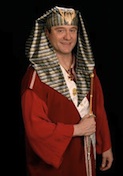 "Let me share with you my own story in facing this problem over the last two decades ..."
"If you would have asked me about Self-Initiation eighteen years ago, when Hermetic Order of the Golden Dawn Praemonstratrix, Cris Monnastre, first appointed me HOGD Imperator, I would have told you: "Self-Initiation is as impossible as self-psychotherapy."
After 18 years as Golden Dawn Imperator, I remain convinced the absolute best way to create a magician is with traditional Golden Dawn initiation - with the Initiate physically present together with a fully trained Hierophant in a physical Golden Dawn temple.
This is because ...
"A good Hierophant can awaken the magical Forces in your energetic body FOR you ...
... since these Forces are fully active in the Hierophant's own energetic body already."
The danger is when I start to believe I am one simply because I can portray one so well that people cannot tell the difference (until I am in the operating room, that is!). My fear of Self-Initiation is someone can portray a magician without ever really becoming one. If someone learns to portray a magician perfectly, they may trick themselves and waste a lifetime living a delusion. The real question is:
"What do YOU want?
... To just do Ritual Magic ...
Or do you want to BE a Magician?
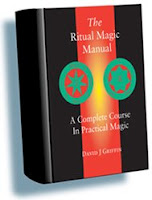 The Ritual Magic Manual fills an essential need for would be Golden Dawn magicians by providing everything you need for the magical component of Self-Initiation on your own, in a complete - step by step - user-friendly format.
In the Ritual Magic Manual, you will find all of the pentagrams, hexagrams, Egyptian God Forms, Enochian and Qabalistic names sigils and names of power, flashing colors, etc. - all in one place!
"The Ritual Magic Manual is packed with all the Rituals practiced by the Magical order. If you have this book along with Donald M. Kraig's - Modern Magick, then you are off in Self Initiation."
- Ixus Radion
"Self-Initiates will find the magical training you need here. Solitaries will find no more thorough a reference manual. Pagans will find the Golden Dawn's "Book of Shadows." Thelemites will find 'Liber O' on steroids."
- Frater WA
"Everything needed to complete GD basic magical training is between these covers - with some vital extensions of the Enochian Work too... pronunciation guides, 12 Zodiacal Kings, Colour and the Sigillum, etc."
- Ad Astra
"As to the overall accuracy of names and sigils in this book, Griffin notes the instances where he corrects (or deviates from) established sources: examples of this include (much-needed) revisions to the Hebrew spellings of the Qlipothic hierarchy given in Crowley's 777."
- David L. Smith
28. Is there anything still Secret in the Golden Dawn?
This depends completely upon each individual order. Most Regardie-based groups dead-end with the Adeptus Minor (5=6) material published by Regardie. The European headquartered, Hermetic Order of the Golden Dawn goes far beyond this with a completely traditional and extremely substantial magical and alchemical curriculum derived entirely from pre-Golden Dawn, Hermetic and Rosicrucian esoteric transmissions and initiating and teaching in the entire three order system originally envisioned for the Golden Dawn, from the Neophyte (0=0) grade, all the way through the Ipsissimus (10=1) grade.
29. Are Golden Dawn Temples still active? How can I become a member?
You should begin by contrasting the array of Golden Dawn and Rosicrucian groups contained on the Golden Dawn Groups list on this website.
No part of this site may be reproduced in any form, electronic or otherwise, without expressed written permission.